
A Record Number Of Uber Miles Are Happening In EVs
Ride-hailing company Uber is seeing record electrification stats.
Over 424,000 Uber drivers were behind the wheel of an EV in Q3, up 52% from the same period last year.
In the previous quarter, Uber EV drivers across the world completed over 26 trips every second, on average.
Uber’s electrification efforts are looking better with every quarter, and this year’s third quarter has shown that the giant ride-hailing company is serious about lowering its fleet’s emissions. That said, Uber is also aware that, based on current trends, its 2030 goals “continue to be out of reach.”
Let’s focus on the good news first. Last quarter, Uber drivers across the globe completed a whopping 207.4 million rides in EVs, which boils down to over 26 EV trips on the ride-hailing platform every second, on average. Compared to the same period last year, the number of EV trips on the platform is 52% higher, but the big stats don’t end here.
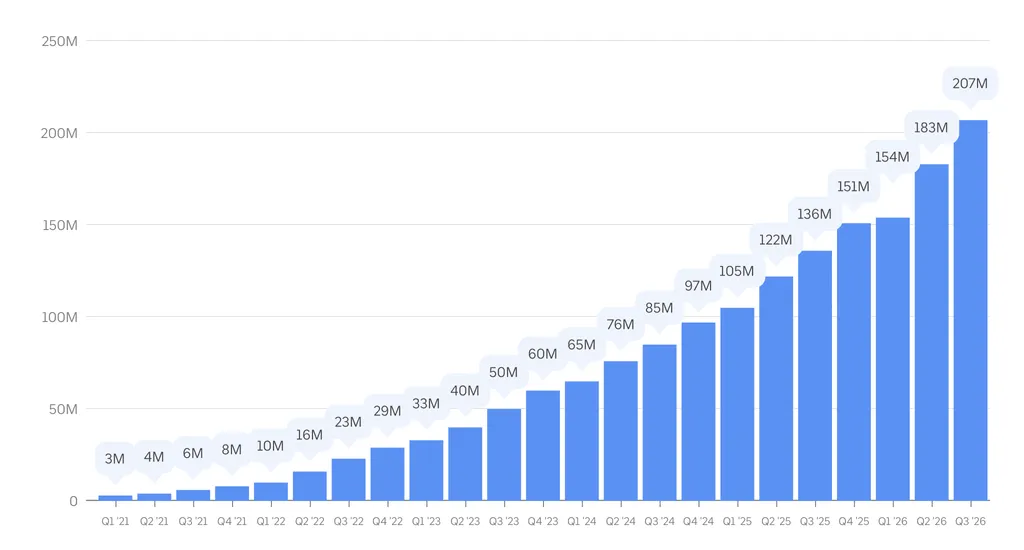
Global Uber trips completed in zero-emission vehicles in Q3 2026
Photo by: Uber
In Europe, one in five Uber trips were done in an EV, while one in ten Americans and Canadians who took an Uber in Q3 wound up in an electric car. On average, there were 434,000 EV drivers active on Uber from July through September globally, up 52% from the same period last year,
When looking at the charts provided by the ride-hailing company, the difference between Europe and the U.S. and Canada is astonishing. Even from the start of the chart, in Q1 2021, Europe had a consistent lead when it comes to electrification, but the two North American countries were left in the dust starting in the third quarter of 2024. European drivers flocked to EVs, helped by various incentives and a boost in the charging infrastructure, while Americans' and Canadians’ uptake stayed relatively flat. For its part, Uber has offered cash bonuses to drivers who wanted to switch to an EV.
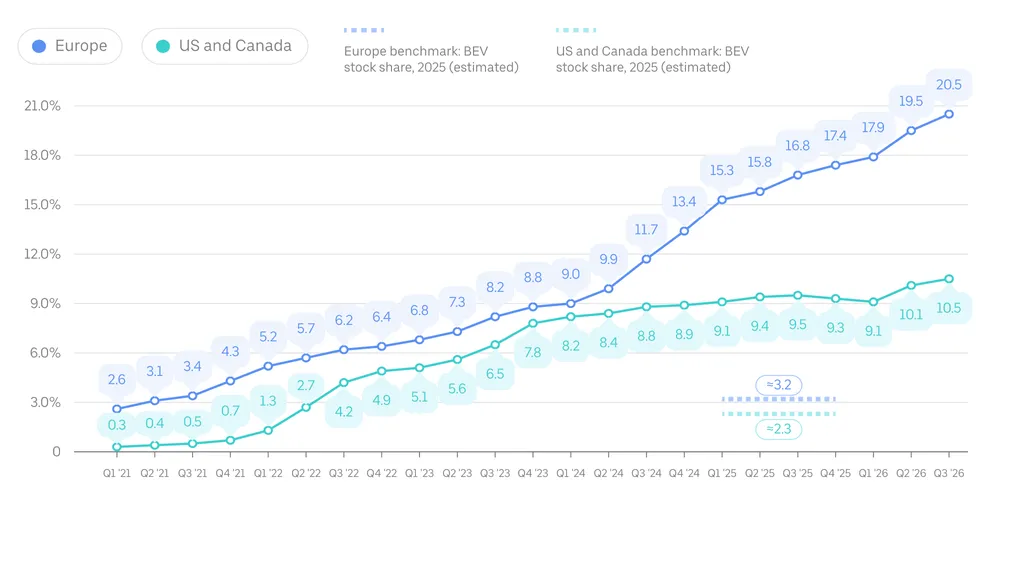
Zero-emission vehicle uptake on the Uber platform in Europe, Canada, and the U.S.
Photo by: Uber
Despite the upward trends seen in the charts provided by Uber, it’s not all good news. The company has missed almost all of its sustainability targets for 2025 and is well on its way to missing its goals for the end of 2030 by a wide margin.
Just as the number of EVs on the ride-hailing platform has increased, plenty of drivers chose gas- or diesel-powered cars to make an extra buck on Uber. In the U.S. and Canada, every mile that a passenger traveled on Uber resulted in an average generation of 318 grams of carbon dioxide. That’s better than 2024’s 340 grams, but worse than the 306-gram average in 2023.
A similar story can be found in Europe, though the average vehicle emissions caused by Uber trips are vastly smaller than in the U.S. and Canada. Last year, 186 g of CO2 were put into the atmosphere in Europe for every mile traveled by a passenger on Uber. The figure is lower than in 2024 and 2023, but higher than the 183 g average in 2022.
The company said that the large gap between Europe and the U.S. and Canada can be linked to two factors. First, European drivers prefer EVs and hybrids more than American and Canadian drivers, but the more stringent fuel economy reporting standards in the U.S. also contribute to this discrepancy.
What do you think?
In 2025, the ride-hailing giant had wanted to see 100% of rides in London and Amsterdam be zero-emission. The outcome was just 41%. Furthermore, 50% of all mobility miles in seven European capitals were envisioned as being completed in electric vehicles, but the year ended with just 32%.
By the end of the decade, 100% of rides in Canada, Europe, and the U.S. should be zero-emission, but Uber is realistic and knows that it’s highly unlikely that it will finish 2030 with these numbers. Still, the company says it’s “deeply committed to this transition,” even though many levers are outside of its control.