
Toray develops a resin film for anode current collectors to cut battery weight
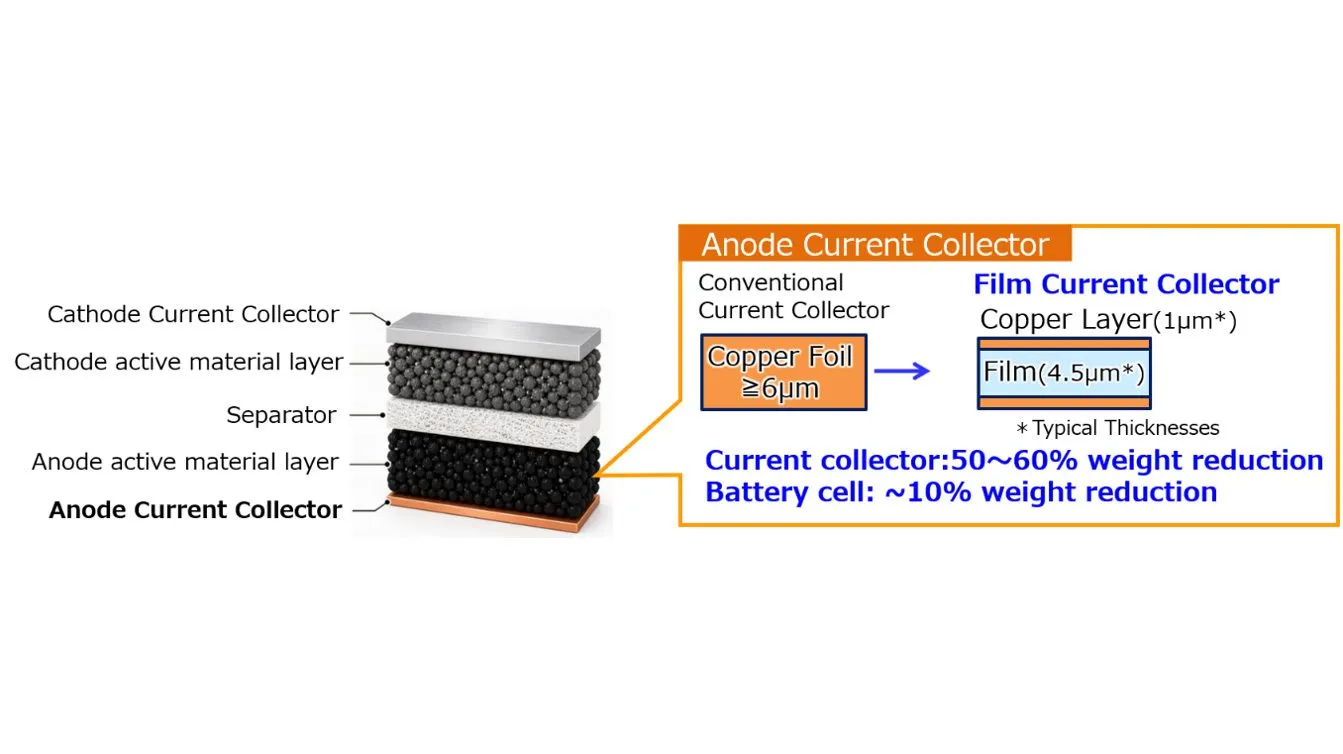
Toray Industries has developed a resin-film substrate for anode current collectors in lithium-ion batteries that it says is the first to meet all four key material requirements at once: resistance to oxidation and reduction, adhesion to the metal layer, mechanical strength and thermal stability. Toray says the film lets battery makers swap the copper foil that anodes conventionally use for a lighter film current collector, a resin film coated with a thin copper layer.
A current collector built on the new film is 50% to 60% lighter than a conventional copper-foil collector, which Toray says should cut battery cell weight by about 10%.
An anode current collector draws current from the battery’s anode. Polyethylene terephthalate (PET) film already serves as the resin substrate on the cathode side but degrades in the strongly reducing environment at the anode, which had kept resin substrates out of anode current collectors.

Comparison of copper foil and film current collectors for anode applications
Toray built the new substrate using its polymer alloy technology, blending two or more polymers to reach properties a single resin cannot. It says the film resists reduction and bonds strongly to the copper layer, matches copper foil in mechanical strength and shows low thermal shrinkage. Toray says battery cells using it performed comparably to conventional copper-foil current collectors.

Toray assessment of capacity retention during battery cycling tests
(using single-layer laminate cell with battery capacity of 30 milliampere-hours)
Because a current collector is inactive mass, trimming its weight raises the cell’s specific energy, which Toray says can lengthen run times for mobile devices and extend drone and vehicle range. Toray estimates that if the weight savings go toward more cathode and anode active material and electrolyte, keeping the negative-to-positive capacity ratio constant, the film could extend electric vehicle range by up to 10%.
Toray has produced a standard grade of the film at 4.5 microns thick on mass-production equipment and has begun sending samples to customers. It is working to make the film thinner. The company plans to commercialize the film in small and medium batteries for mobile devices, drones and electric vertical take-off and landing (eVTOL) aircraft, and is studying its use in larger batteries for electric vehicles and energy storage.