
LANXESS opens a battery laboratory to test iron oxide and iron phosphate in LFP cells
EV Engineering News
Posted September 15, 2026 by Chris Ruoff & filed under Newswire, The Tech.
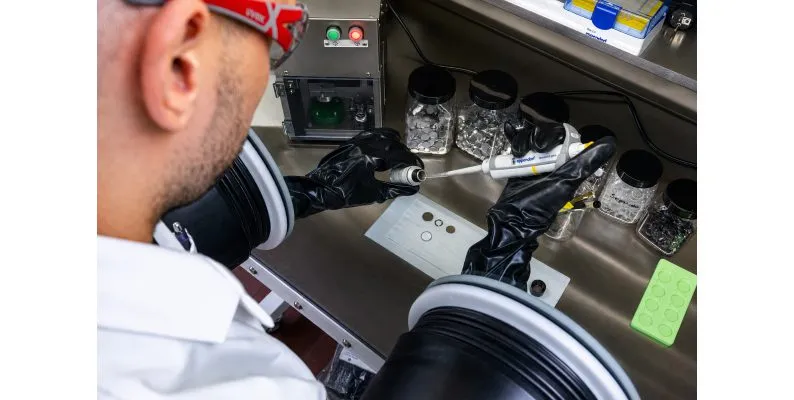
LANXESS has opened a battery laboratory at its Krefeld-Uerdingen site in Germany, where the specialty chemicals company tests and develops battery materials based on iron oxide and iron phosphate, the precursors used to make lithium iron phosphate (LFP) cathode material.
The laboratory lets LANXESS test the material properties of its products directly in battery cells. That, the company says, lets it and its customers judge more quickly how a given iron oxide or iron phosphate grade affects cell performance, processability and suitability for a particular application. The equipment also suits other battery types, including sodium-ion cells, which use sodium iron pyrophosphate as their cathode material.
Three-quarters of electric vehicles in China already use LFP batteries, LANXESS says, and management consultancy Roland Berger forecasts that LFP will hold 50% of the European market by 2030, up from 10%. The company points to stationary storage for renewable energy, data centers and critical infrastructure as a second source of demand, and to new value chains forming in Europe and North America to cut dependence on Asian suppliers.
The company already sells iron oxide grades tailored for LFP cathode synthesis, and that development won the 2024 ICIS (Independent Commodity Intelligence Services) Innovation Award in the "Best Product Innovation from a Large Company" category. Charged covered the research partnership with IBU-tec that LANXESS announced in 2024 to develop iron oxides for the same application.
Iron phosphate is a second LFP precursor the company has developed, made from iron and phosphoric acid. LANXESS says that route has environmental advantages over conventional methods, which produce large volumes of saline wastewater.
Its wider battery portfolio includes chemicals for electrolyte salts and Lewatit ion-exchange resins used to extract and refine lithium, nickel and cobalt. It also supplies synthetic coolants for high-voltage applications, colorants for safety-critical orange high-voltage components and flame retardants for plastics and electrolytes. For recycling, the company sells process chemicals and ion-exchange resins for processing black mass, recovering metals and treating wastewater.
"What matters is the reliability of processing and its contribution to cell performance," said Murat Gürsoy, LANXESS's Head of Innovation for Iron Oxides and Iron Phosphate. "This is precisely where our laboratory comes in. We bring material development and cell testing closer together. This gives us an earlier indication of whether a material works in a real cell assembly."
Source: LANXESS
Create Account. Already Registered? Log In
Virtual Conference on EV Engineering: Free to Attend
Don't miss our next Virtual Conference on September 14-17, 2026.
Register for the free webinar sessions below to reserve your spot and watch them live or on demand.
LOAD MORE SESSIONS