
How EV Realty chooses sites for electric truck charging hubs
EV Engineering News
Posted October 28, 2026 by Charles Morris & filed under Features, Fleets and Infrastructure Features, Infrastructure Features.
EV Realty sites its heavy-duty EV charging hubs where the fleet customers are.
Heavy-duty EVs have different charging requirements than passenger EVs. As electric truck guru Rustam Kocher explains in our recent interview, a charging hub purpose-built for heavy-duty EVs differs from a consumer charging hub in several ways. But it’s not just the physical design of the site that differs—the business model is a bit different too.
Passenger car drivers stop off to charge whenever their battery gauges (or their bladders) tell them to, so charging operators focused on this market have to choose likely locations and wait for customers to drive in. Fleet customers are more predictable—their trucks tend to run regular routes, and they need to count on being able to charge exactly when and where they need to. Therefore, companies that serve the heavy-duty market tend to offer charging on more of a subscription basis, and they build charging sites with specific customers in mind.
As any real estate investor will tell you, location, location, location is all-important. That’s why the vast majority of heavy-duty charging hubs are currently located in Southern California, near the giant port complexes of Los Angeles and Long Beach, in the midst of the surrounding sprawl of warehouses and logistics centers. But there’s more to choosing a site for a charging hub than simply picking a strategic location.
EV Realty was launched in 2022 to provide turnkey charging solutions for electric truck fleets. As its name implies, the company sees value in owning strategic locations. Its strategy is to acquire, develop and operate optimally sited, grid-ready properties to support regular freight and logistics customers.
We have the capability to take a site from a piece of dirt all the way through to an operating charging project.
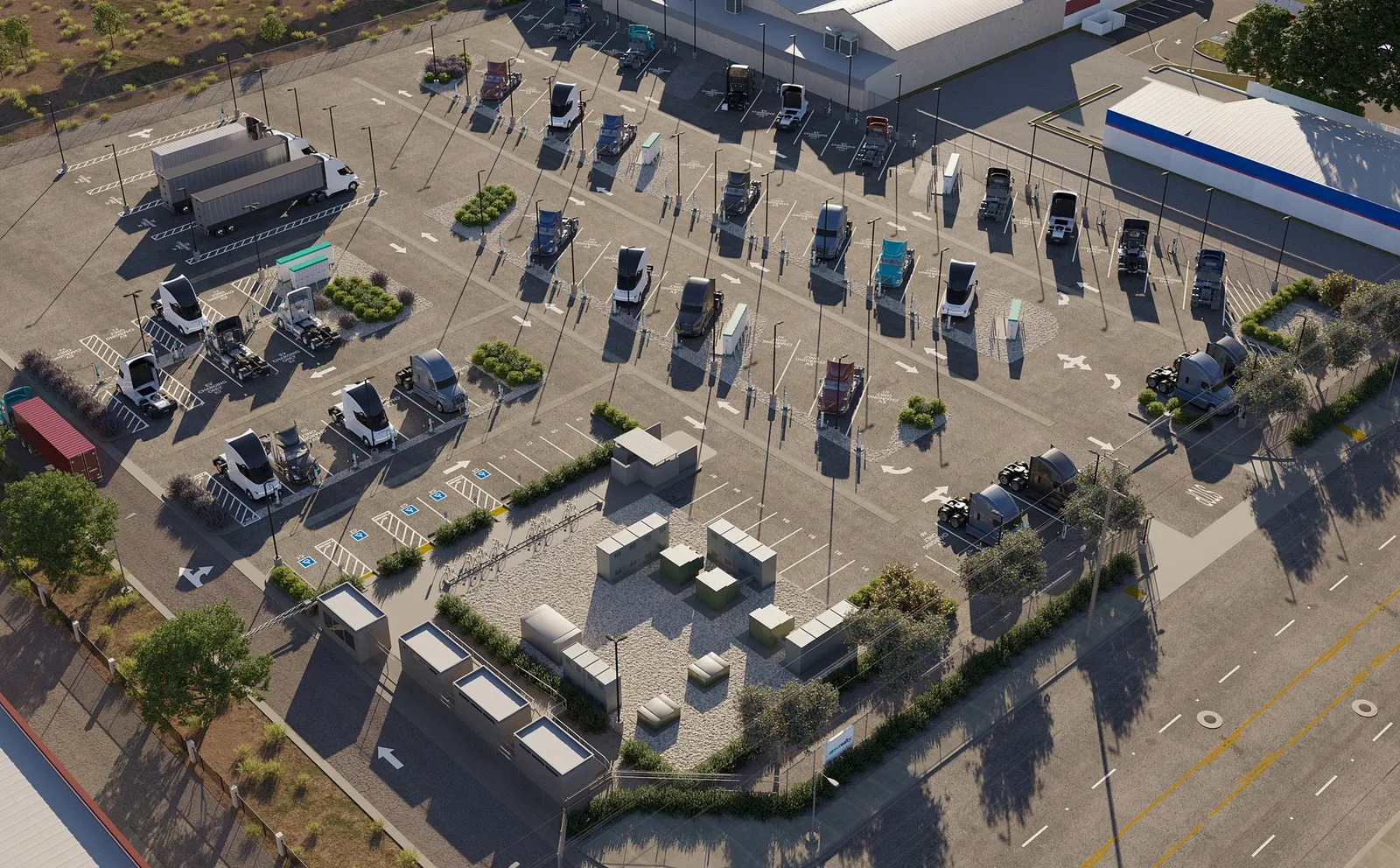
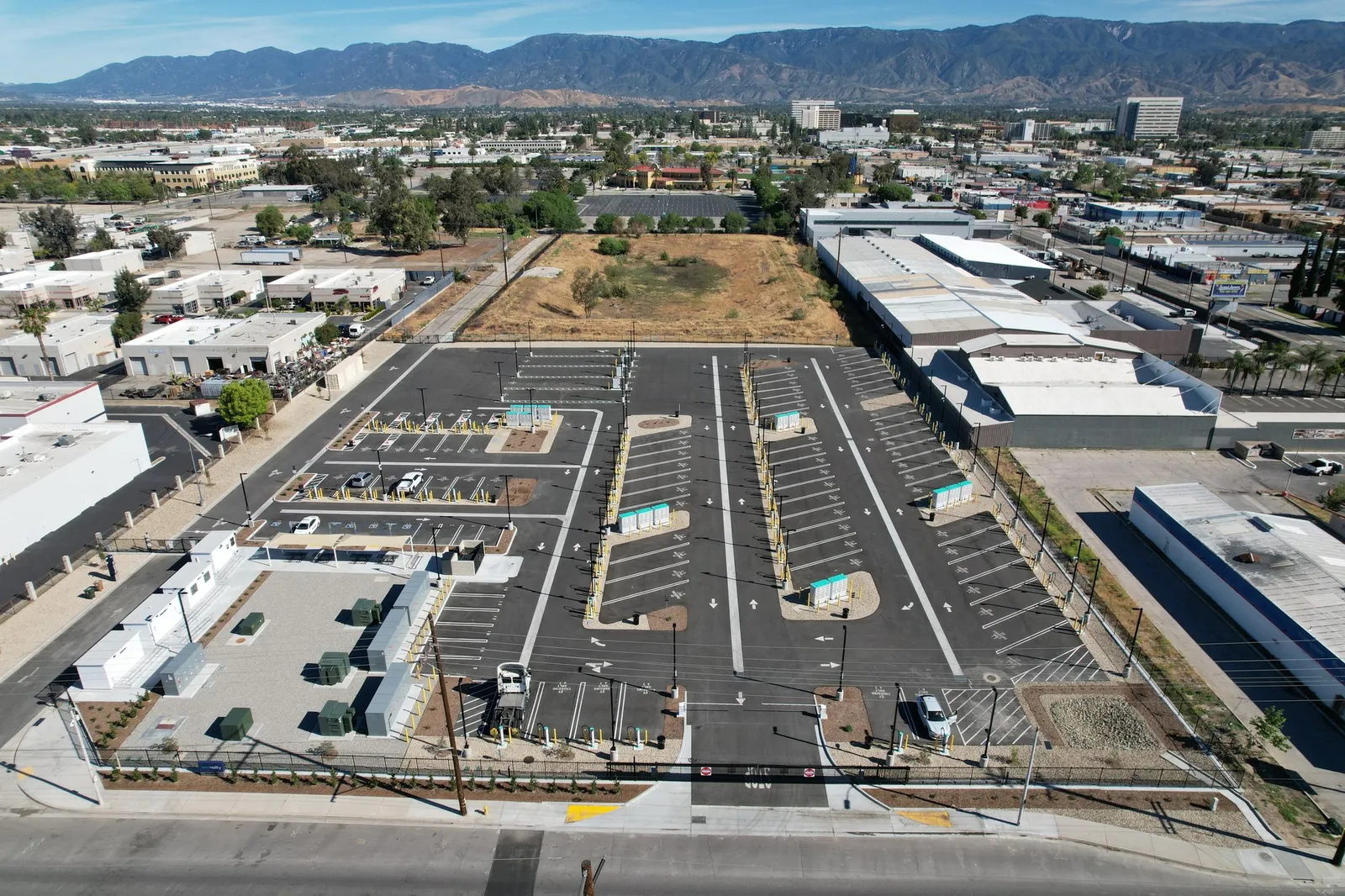
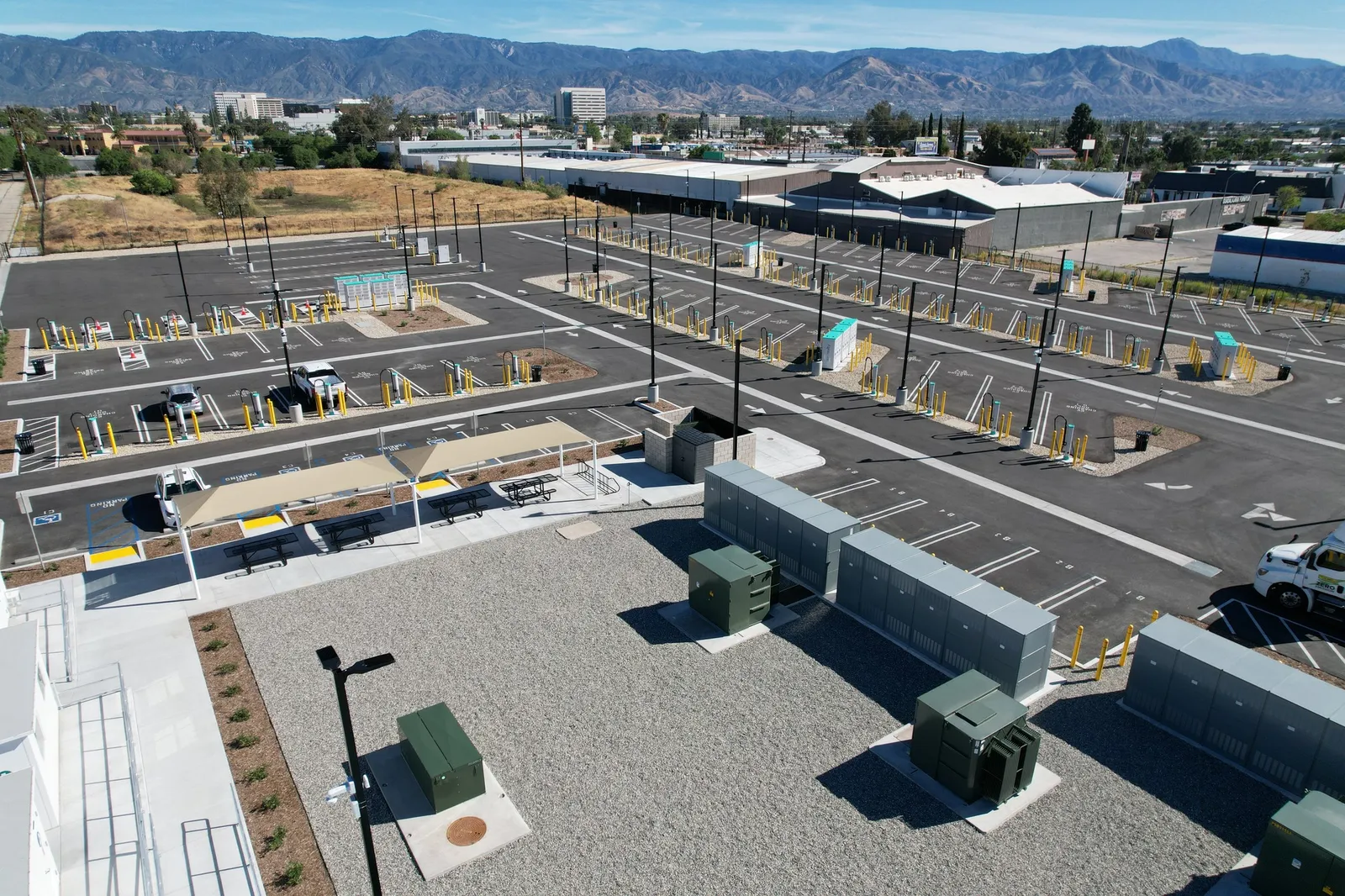
In April 2026, EV Realty opened its first Powered Property in San Bernardino, in an area that’s home to around 17,000 medium- and heavy-duty trucks. The charging hub features 76 high-power charging ports and 9 MW of total power capacity, sufficient to serve over 200 trucks per day. The Kempower charging hardware allows charging at up to 500 kW with CCS and up to 1.2 MW with MCS. Fleet management software from Synop allows customers to make reservations and to receive comprehensive reports on cost, range and efficiency. On-site staff, parking and on-site amenities are available 24/7.
Announced customers include national carrier J.B. Hunt Transport, beverage distributor Gate City Beverage and electric carrier Nevoya.
In September 2026, the company acquired a new site in Ontario, California—an equally strategic location not far from the San Bernardino site. Construction there is to start in 2027.
Henrik Holland, a veteran of the energy and venture capital industries and Board Chairman of Catalyst Mobility (formerly CALSTART), recently joined EV Realty as President. He chatted with Charged about the details of site selection, the importance of interfacing with utilities, and where the charging industry fits into the emerging energy ecosystem.

Charged: Tell us a bit about your personal background and how you ended up at EV Realty.
Henrik Holland: I’ve been in the energy industry for 23 years. I started my career at Shell in 2003. I always had a passion for the renewable side of the business, and finally in 2013, I got an opportunity to make that step by joining Shell Technology Ventures. I moved from the Netherlands to the US and led clean-tech venture investing for a while. Looked at lots of businesses and made investments in the clean energy space, spanning a range of technologies and business models.
That period of time led to the development of the company’s distributed energy business here in the US.
In 2018, I was asked to develop the go-to-market strategy for the mobility side of the business in the US, because I knew the space and the investors so well. We acquired charging software provider Greenlots in 2019. That was our entryway into the market. I took an operating role at the company. Did that for about a year and a half, and I got to know the space really well by looking at it through an M&A lens, but also through being responsible for energy for the solutions that we were offering our customers on the charging side. We were providing utilities with software, with turnkey projects. I ran the team that worked with Fortune 100, 500 companies on their early charging deployments, from delivery vans to heavy-duty trucks.
I was also responsible for our lab, so I have a lot of experience with interoperability testing. We ran interoperability testing for 20-plus hardware vendors in our lab. We had companies like GM and Ford come in with their vehicles to test how they would work with different types of charging hardware.
I started to see that, as they were doing their first deployments, customers were piecing the projects together. They were buying software and chargers themselves, even though we would execute them as a project. And I started to believe that the industry needed more integrated fleet solutions, and that in the future, you would see fueling infrastructure for electric fleets at warehouses.
I joined Prologis to build out that strategy, which I think we did quite successfully—grew that to a network of about 70 megawatts between the US and Europe. We ended up doing hundreds of projects between light-duty and heavy-duty. Did that at depots behind the fence for onsite fleets plus whoever might be visiting at that location. We also developed charging hubs.
I’ve also learned that a key bottleneck in this transition is the real estate to make it happen, and that efficient, cost-effective and timely site development takes a marriage between two otherwise pretty separate sets of expertise: real estate development and the charging and energy side.
So, I’ve operated across the charging space. I am of the view that the world of stationary distributed energy, onsite storage, generation, energy management in general, is coming together with the mobility world to be able to get vehicles going reliably and at the appropriate level of cost from a fueling perspective.
That’s what got me to EV Realty. I think this is the platform where a lot of those things come together. I’ve also learned that a key bottleneck in this transition is the real estate to make it happen, and that efficient, cost-effective and timely site development takes a marriage between two otherwise pretty separate sets of expertise: real estate development and the charging and energy side. How do we get a site energized? How do we work with utilities? How do we think about the tariffs that the sites are on? How does the way that customers want to use their vehicles interact with that energy system? If you charge at the wrong time, you might be hitting high demand charges. You want to make sure that those types of things don’t happen.
Larger corporations may not be the ones who are spearheading the development of an industry. When you’re doing innovation in a larger corporation, you’re not generally in the core business of that company. It’s easier to innovate if you are working within a company like EV Realty that is built to push the envelope. And I fundamentally believe that EV Realty has the right investor behind it in NGP, which is committed to this journey.
Charged: We talk a lot about the charging stack these days. I’ve talked to companies that provide one part of the stack, or several layers of the stack. Some offer charging as a service, some offer trucks as a service. When one founds an infrastructure company, presumably one has to ask, Which parts of the stack should we focus on? Where do we see the most opportunity? I haven’t talked to many companies that focus on the real estate aspect, although that’s obviously very important.
Holland: I think I can speak to that, because I joined a real estate company in the summer of 2021, around the same time that Patrick Sullivan founded EV Realty. Patrick and I have always been aligned about where we see value in the stack. The foundation of the stack is where these sites actually are—the real estate.
On top of that, you have the hardware. Then you have the energy component, be that utility-provided and/or combined with some form of onsite energy management. On top of that, you have the software that ties it all together. That’s my model of the charging stack. Then of course you have the vehicles that consume the product that’s created with that stack.
Now, where can you actually make money? I think there’s money to be made in all of those levels, and you could take the view as a company that you want to operate across all of them and be vertically integrated. My belief is that a significant, enduring part of the value of that stack is the siting, the location of the real estate, because that’s the thing that can’t change, and it’s in limited supply. What’s more, if you combine that with energy, we’re talking about something that is even more constrained and in limited supply.
So, there’s two angles to this. One: for this transition to happen, the market needs to have access to cost-effective, energized real estate, or there’s not going to be any places to charge these trucks. Two: because this is a limited resource, there is a lot of long-term value to be created by developing those resources and controlling and owning them.
What’s really important is to understand the energy system really well, to know where bottlenecks are and where you will be able to energize within a time period that we would consider acceptable.
Charged: EV Realty has bought some existing sites—truck parking lots or industrial sites in strategic locations—and developed charging hubs there. Is that a better way to go, because you have part of your work done for you already? Or is it better to start from a greenfield site and build from the ground up specifically for electric trucks?
Holland: Every site is different, and we qualify locations on a number of criteria. To a degree, whether it’s a greenfield site, a graded lot, a truck yard or even a five-decade-old warehouse that needs to be demolished and redeveloped, doesn’t matter a whole lot for us. We have the capability to take a site from a piece of dirt all the way through to an operating charging project. What is more important to us is the cost basis of the site. Is it in the right location? And can we get power there within a reasonable period of time and at the appropriate cost?
We have a proprietary site selection platform called Compass, which takes a wide variety of data into account, including utility data. What’s really important is to understand the energy system really well, to know where bottlenecks are and where you will be able to energize within a time period that we would consider acceptable.
Charged: Can you tell us a bit about your customer mix?
Holland: At our San Bernardino site, the customers are heavy-duty fleet customers. We also work with the autonomous vehicle providers across the sector. But we are not being public yet about any particular deals.
Charged: I ask everyone about MCS and V2G. Are these still pilot technologies, or are we seeing some commercial deployments?
Holland: Let me start with MCS. I think that one’s out of the garage, both here in the US and in Europe. In Europe, the conventional OEMs are a little farther along with their MCS truck deployments, but at San Bernardino we built one of the first MCS charging sites in the country. I believe that MCS is going to be an important part of the equation going forward. It provides the type of charging time that customers are looking for. It’s not necessarily going to be what you want to do for all use cases, but it’s important in the heavy-duty sector because you’re dealing with much larger battery volumes. It’s great that the industry is converging around open standards.
On V2G, I think we are moving towards a world with a smarter grid, and that goes for distributed energy resources as a whole. We’re going to see more onsite storage—behind-the-fence, behind-the-meter storage, solar. Utilities are increasingly going to find ways to integrate those resources into the grid and the DSOs. Over time, will vehicle batteries play a role in that as well? I think so, to a degree. Is that where I would start today? Is it a transformative technology that is going to catalyze our industry in the near term? I’m a bit more skeptical about that. But I do think that it’s part of a bigger piece that we’re going to see come together long-term.
You’re already seeing it in segments where it makes sense. School buses, for example, where you have a system sitting stationary for a long period of time with significant battery capacity. For V2G you need to have a lot of scale, a lot of vehicles connected, for that really to have an impact. So I think we’re going to see a lot more V2G deployments when we have a lot more EVs on the road.
If you’re competing with a truck actually doing what it’s intended to do, V2G doesn’t create enough value to do that. You do that with a stationary storage system.
Charged: It seems to me that the only going concerns so far are school bus applications. Maybe for trucks, it’s not as great an application because fleets don’t want their trucks sitting for long periods of time.
Holland: Exactly. V2G is an enabling technology to achieve something, but what? Smarter use of the grid, load reduction, cost reduction—and you’re only going to be able to do that where you have the right operational duty cycle. If you’re competing with a truck actually doing what it’s intended to do, V2G doesn’t create enough value to do that. You do that with a stationary storage system.
Charged: Anything else you’d like to discuss? Any new projects in the pipeline for EV Realty?
Holland: Well, today we announced the acquisition of a new location in Ontario, California. We’re very excited about that addition to our portfolio. One thing to add is that my mandate is to support our growth nationally—the capability we’re talking about here is something we can bring to bear across the country. So far we have been very focused on California, because that’s where our customers wanted us to be. But we have been increasingly seeing opportunities outside of the state as well, so there will be more to follow on that.
This article appeared in Issue 77: July-September 2026 – Subscribe now.
Create Account. Already Registered? Log In
Virtual Conference on EV Engineering: Free to Attend
Don't miss our next Virtual Conference on September 14-17, 2026.
Register for the free webinar sessions below to reserve your spot and watch them live or on demand.
LOAD MORE SESSIONS