
Mazda 6e review: The incomplete package
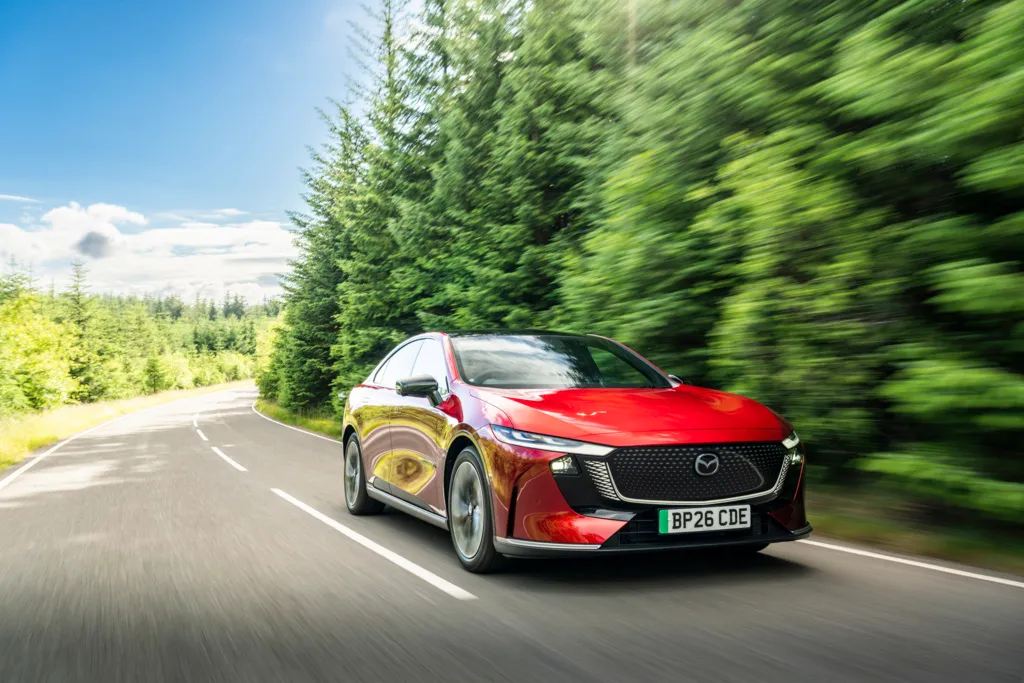
2OUT OF 5
The verdict
Badge engineering at its worst
Mazda has put its name to a product that fails to honour either its reputation for driving dynamics or intuitive operation. Deeply disappointing
★★★★★
Mazda has always been known for taking an “individual” approach to motoring innovation. From its radical rotary engines to diesel-style compression ignition in petrol cars, it’s always gone its own way, even when convention suggests it shouldn’t.
The shift to electrification is a case in point. While even similarly reluctant Japanese brands such as Toyota have thrown themselves into building EVs, Mazda has held back, insisting there’s a future in combustion engines.
Undoubtedly, in some markets, there remains a strong demand for petrol power, but in Europe, the tide has turned in favour of electric, leaving Mazda high and dry.
After poor performance from its first in-house EV – the MX-30 – Mazda decided the best approach was to enlist help from those more experienced in new energy vehicles. So for its second attempt – the Mazda 6e – the brand turned to China’s Changan.
Not only is the Mazda 6e based on a modified version of the Changan Deepal S03, but it’s also built in China, in the same factory. But Mazda insists this isn’t just a Changan with the badges swapped. It says it’s modern reinvention of the much-loved Mazda6.
Design and interior
From the outside, you’d certainly be convinced.
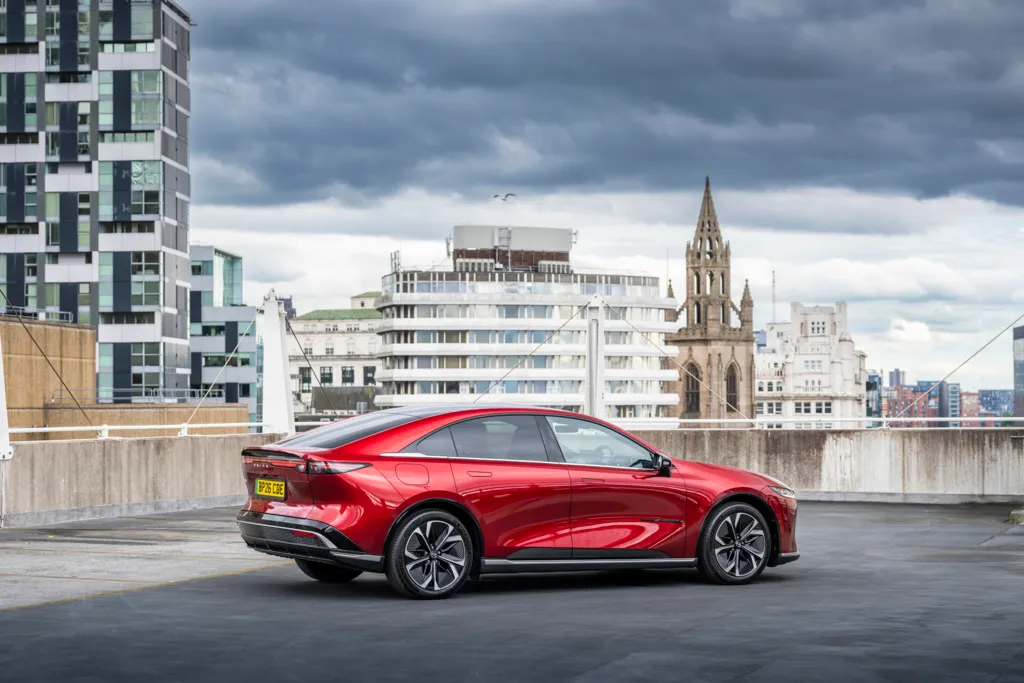
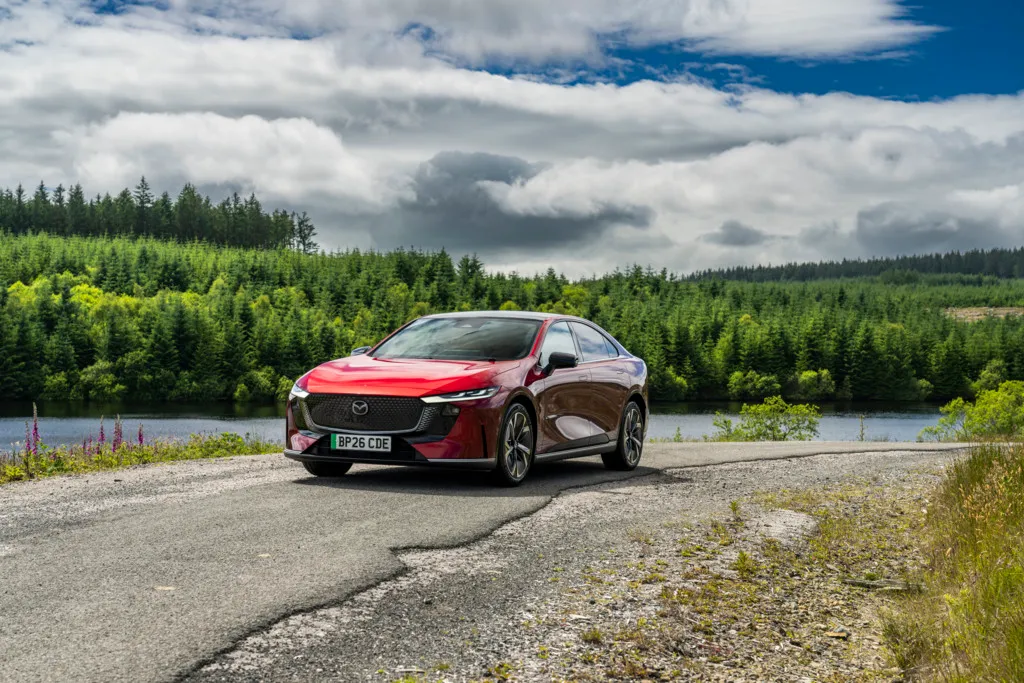
Mazda has long been famous for its clean elegant designs and the 6e continues that. Its long low silhouette looks like an evolution of the old 6, even though this is a completely different car.
There’s the same softly sculpted lines that emphasise the slippery, aero-friendly fastback shape but disguise the car’s near-five-metre length. Aero features such as the smoothed-off grille area with illiminuted “wing” design help boost EV efficiency, along with the electronically controlled rear spoiler that sits above the Mazda tailgate script set in a full-width light bar.
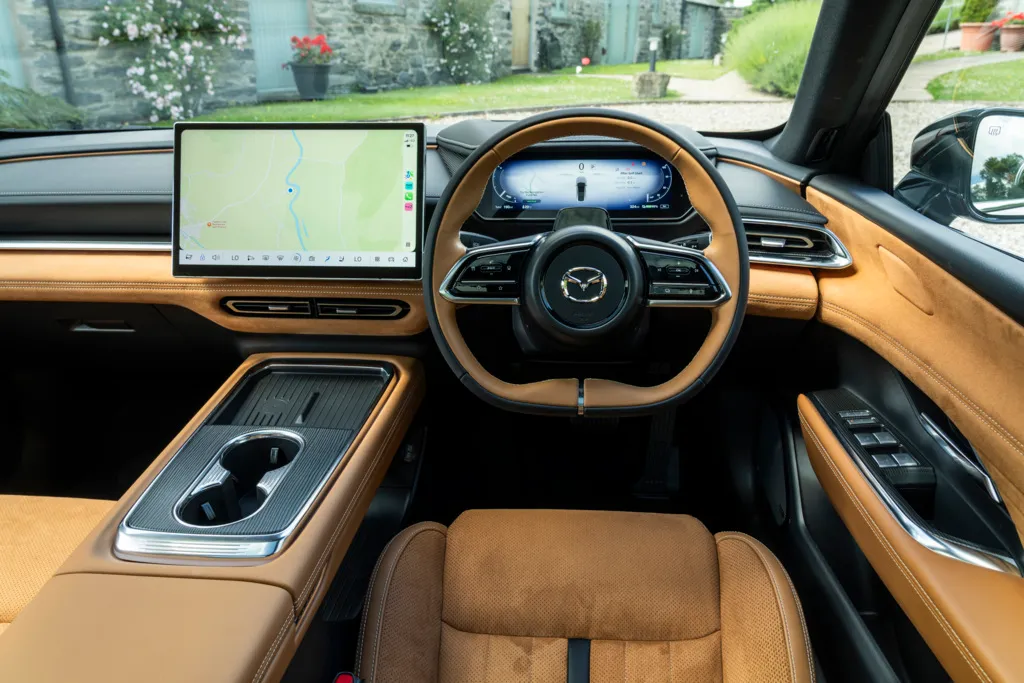
The familiar Mazda feel continues when you open the doors and climb on board – at least initially. My test car’s cabin was finished in a wonderful caramel-coloured mix of faux suede and Nappa leather, and the finish on the seats, doors etc looked and felt suitably premium and in keeping with Mazda’s tradition. Poke and prod at the minimal switchgear and it also feels fairly well screwed together, although not as solid as Hiroshima’s usual offerings.
It’s also plenty spacious enough for four. The sleek roofline means there’s not endless headroom for the excessively tall, but there’s good legroom in the back and an airy feel thanks to the panoramic sunroof. A 446-litre boot (to the roof) offers decent storage and is accessed via a full hatchback tailgate, despite the saloon looks. There’s also a handy 72-litre frunk.
However, the longer you spend in the 6e, the less like a Mazda it feels. The driving position is peculiar – with very little adjustment – and there’s none of the usual unique touches or character. The biggest giveaway that this isn’t really a Mazda, though, is the complete lack of physical controls. There are window switches and two stalks, both lifted from the Great Chinese Parts BinTM, and that’s it.
Everything is controlled via the 14.6-inch central touchscreen, which is backed up by a 10.2-inch digital instrument display, and lies at the heart of the 6e’s problems.
Technology and equipment
When I say everything is controlled via the screen, I’m not kidding. From the wing mirrors and sunroof shade to the speed of your windscreen wipers and the headlight functions, it’s all in the screen.
The system itself is responsive and the screen is big and sharp, but it’s a seemingly endless mass of unintuitive menus, sub-menus, icons, shortcut buttons and more menus. Key functions are buried beneath multiple screen presses while pointless rubbish is pushed to the fore. Trying to use it while in motion is bordering on the dangerous.
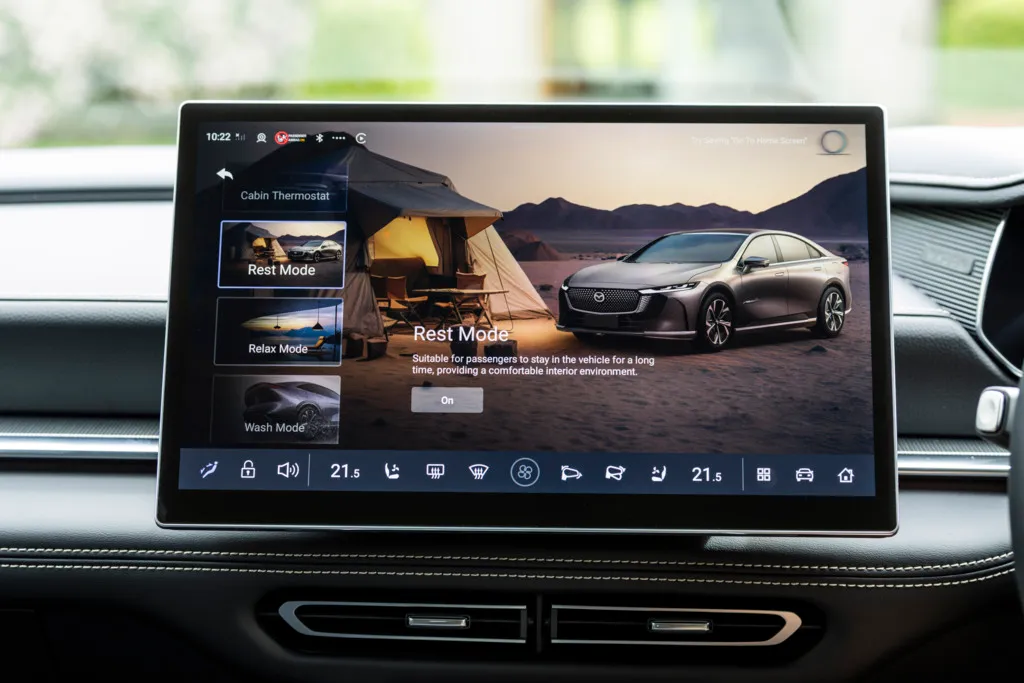
When it is quicker and easier to find out a car’s chipset details than it is to activate the heated rear screen, you have fundamentally failed as a car maker. And that’s not a joke.
Mazda has for decades, talked about the “jinba-ittai” horse and rider concept – the idea of a natural dialogue between driver and vehicle that makes for engaging driving and ease of use. There is none of that here. Neither in the user interface, the overbearing way the driver “assistance” intervenes, or the way it drives.
On the subject of driver assistance. It’s poorly calibrated, unreliable and overly intrusive – everything that you don’t expect from a Mazda.
Perhaps in a bid to distract from its shortcomings, the range-topping Takumi Plus version of the Mazda 6e comes with plenty of kit, from that Nappa leather trim and heated and cooled seats, to the panoramic sunroof, a 14-speaker Sony stereo and adaptive cruise control.
Range, battery and charging
Before the 6e even launched in the UK, Mazda made some quite significant changes to the European-spec car. While that came with a couple of battery and motor options, we now get just one improved powertrain offering.
This mates a 254bhp rear-mounted motor with a 78kWh battery which offers an official range of 348 miles and energy consumption of 3.86m/kWh.
Over a week of pretty varied driving, the Mazda 6e returned a real-world range of 287 miles and real-world energy consumption of 3.4m/kWh. Both are what I’d class as perfectly acceptable for this size of vehicle, but neither is earth-shattering and several rivals offer more.
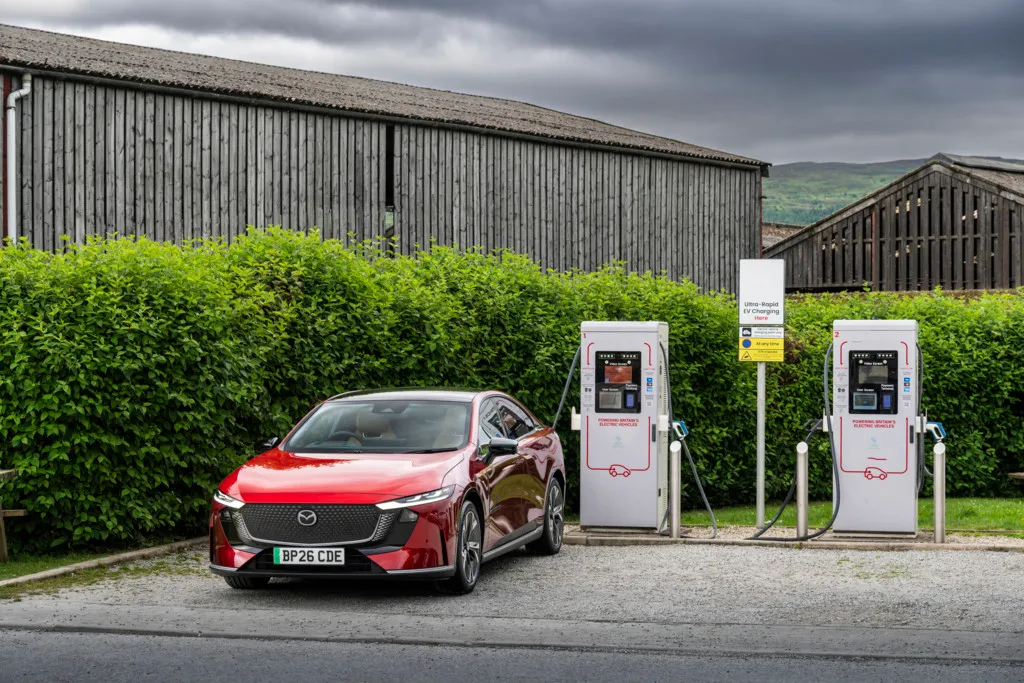
The biggest improvement over the early European cars, though, is in charging, which has been boosted from an embarrassing 90kW to 200kW peak DC. That’s powerful enough to deliver a 10-80% top-up in a very respectable 24 minutes.
The Mazda 6e also comes with 11kW AC charging capability as standard.
Performance and driving
I first drove the Mazda 6e a year ago in an early left-hand-drive configuration that left me beyond disappointed.
Since then, as well as revising the battery and motor arrangement, Mazda has clearly been at work on the car’s chassis.
There’s no doubt that the ride and handling have improved over the early cars I drove. They’ve gone from unacceptable to simply poor.
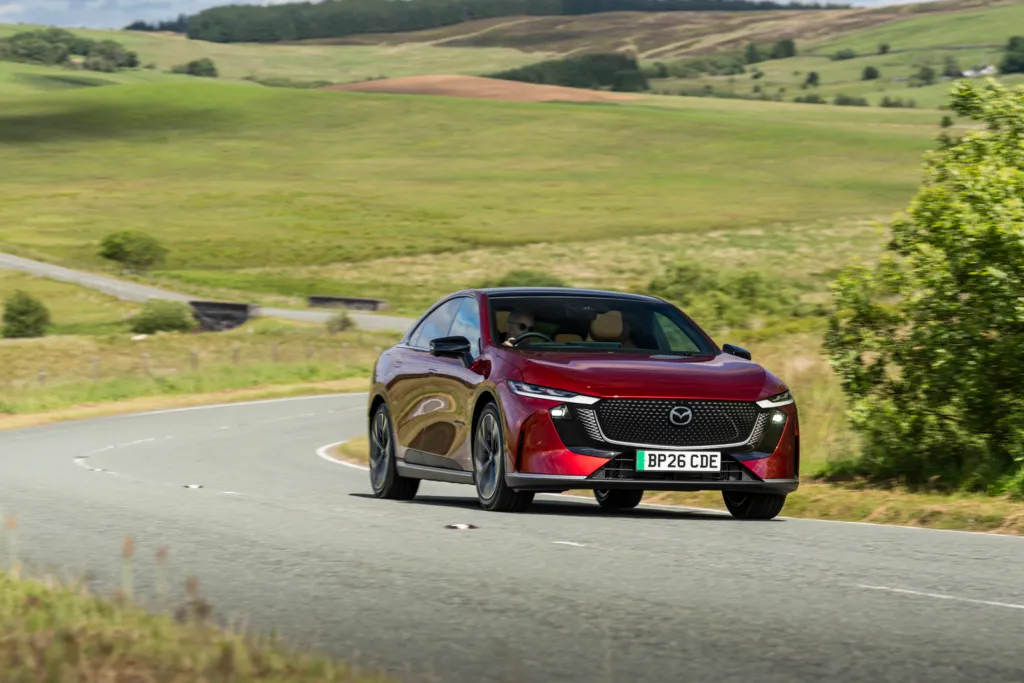
The ride feels unsettled no matter your speed, driving style or the road surface. It’s not crashy in the overly stiff way some cars are, but there’s a constant chatter from the suspension that will get wearing on long journeys. That might be acceptable if this was some sharp-handling star in the way that Mazdas often are. But sadly it’s not, the steering has more weight and directness than those early cars but it’s still vague and lifeless and paired with an oddly calibrated throttle and brakes that make driving feel like hard work.
In a new, cheap, unfamiliar Chinese car it wouldn’t be much of a shock, but in a car bearing the Mazda badge, it’s a disappointment.
More positively, find a smooth, straight stretch of motorway and it is at least a supremely quiet cruiser.
Price, trim and rivals
Mazda’s bigger models have always occupied a slightly odd place in the market. They’re not quite “full-on” premium in the way of Audi or BMW but they’re also noticeably posher than most mainstream brands, which has sometimes made it hard to identify rivals.
Previously, you’d look to the Ford Mondeo and Skoda Superb, but for the all-electric 6e, key rivals are the Tesla Model 3, the Polestar 2, BYD Seal and the Hyundai Ioniq 6.
Against most rivals, the Mazda scores a hit with its competitive pricing. The Mazda 6e range is priced from £38,995. A Polestar 2 or BYD Seal, by comparison starts at around £45,000. However, Hyundai has just slashed the entry price of the 422-mile Ioniq 6 to £33,000.
There are just two trim levels – Takumi and Takumi Plus. Every car gets 19-inch alloys, LED lights, heated and cooled front seats, a heated steering wheel, dual-zone climate control and the panoramic sunroof. Upgrading to Takumi Plus costs £1,000 and simply replaces the black fabric upholstery with tan Nappa leather.
Verdict
There is no question that Mazda has improved the 6e over early European models. Battery, range, charging and performance are better than before and some of the biggest problems with the ride and handling have been addressed.
It looks good, too, but, beneath the sharp suit, it remains a disappointing affair with sub-par dynamics and a truly appalling user interface.
For
Great looks
Spacious interior
Reasonable range and charging speed
Against
Criminally bad user interface
Unsettled ride
Lifeless handling
Fact file
Mazda 6e Takumi Plus
Price
£39,995 (£40,995 as tested)
Powertrain
Single-motor, rear-wheel-drive
Battery
78kWh
Power
254bhp
Torque
214lb ft
Top speed
109mph
0-62mph
7.3 seconds
Range
348miles
Consumption
3.86m/kWh
Real-world range
287 miles
Real-world consumption
3.4m/kWh
Charging
up to 200kW
Boot space
466 litres (to roof)
Insurance group
45
The rivals
Alternatives worth a test drive